 Skip to content


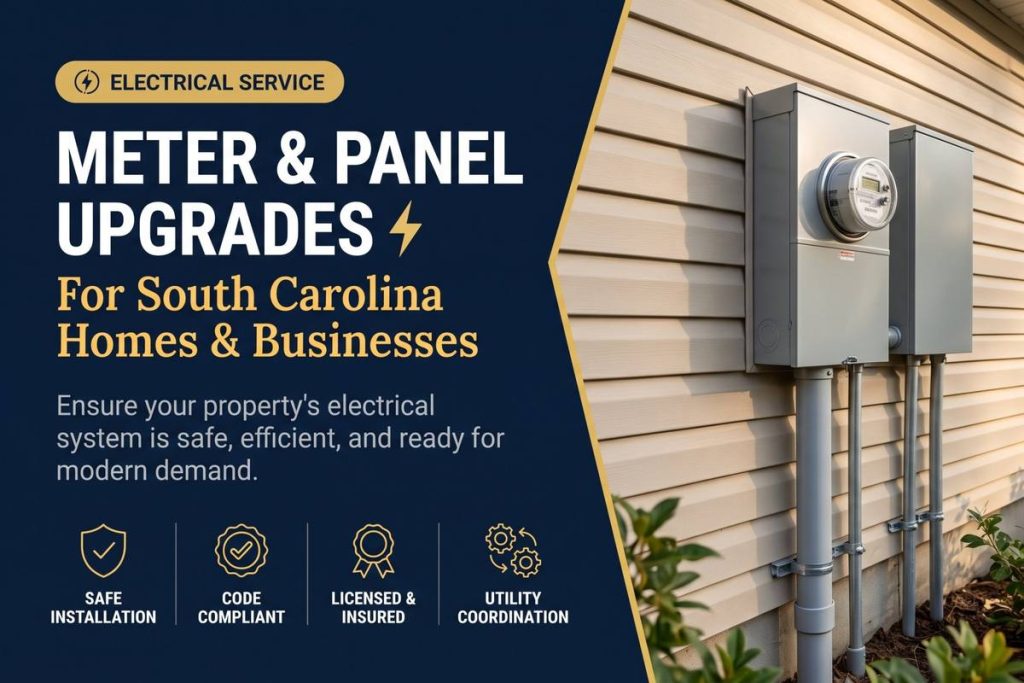
Meter and panel upgrades are how an older South Carolina home catches up with what it runs today. Every circuit starts at the electrical panel, and the panel gets its power through the meter outside. So if your panel is old, full, tripping, or stuck in a closet, it's time to look at an upgrade.
Here's what meter and panel upgrades involve, what the inspector checks, and why smoke alarms come with the job.
In this guide, we'll explain:
- Signs your panel needs replacing
- Panel swap vs. service upgrade
- What gets brought up to code
- Why smoke alarms come with the job
- What to expect on install day
- Common questions
Signs You Need Meter and Panel Upgrades
Most homes give you a warning first, so call us when you see any of these:
- Breakers trip often or won't stay reset.
- The panel feels warm, buzzes, smells burnt, or has scorch marks.
- You still have fuses, or a 60- or 100-amp service.
- There's no room for new circuits, so someone doubled up breakers.
- It's a brand with a bad track record, such as Federal Pacific or Zinsco.
- The panel is in a clothes closet or a bathroom.
- You're adding a heat pump, EV charger, generator, or shop.
- A home inspector or your insurance company flagged it.
If the panel is doing any of that tonight, here's when to call an emergency electrician and when it can wait until morning.
Panel Swap vs. Service Upgrade
Panel Swap
First, a panel swap replaces the panel and breakers at the same size. You keep the same amps but get new, safe equipment.
Service Upgrade
A service upgrade raises the power coming into the house, often from 100 to 200 amps. That usually means a new meter combo, new service wire, and a new panel. Because the power company owns the meter, they disconnect and reconnect it. We set that up with them.
Our Meter Combo Has the Disconnect Built In
On service upgrades, we install a meter combo with a built-in main disconnect. The meter and the shutoff sit in one box outside. As a result, you get the outdoor disconnect the code requires without a second box on the wall.
It also gives you an easy place to run power to a shed, a detached garage, or a pole barn.
What Meter and Panel Upgrades Bring Up to Code
South Carolina uses the 2020 National Electrical Code. So when a panel or service is replaced, the new work has to meet it. Depending on your home, that can include:
- Panel location. A panel can't stay in a clothes closet or bathroom, so we move it.
- Outdoor emergency disconnect. Because firefighters need to kill the power from outside, the code requires one. Our meter combo already has it.
- Two ground rods. You need two ground rods to pass, plus bonding of metal water and gas pipe.
- Whole-home surge protection. New service equipment also needs a surge protector.
- Arc-fault and ground-fault protection. Some circuits may also need AFCI or GFCI breakers.
Your inspector still has the final say. That's why we walk you through it before work starts, so there are no surprises.
Why Smoke Alarms Come With the Job
When electrical work needs a permit, South Carolina's home code requires smoke alarms where a new home would have them. That means one in each bedroom, one outside each sleeping area, and one on every level.
Here's the good news. If no walls or ceilings are opened, battery alarms that link wirelessly are allowed. So there's no cutting drywall to run new wire. Then, when one alarm sounds, they all sound.
If walls are already open, we install hardwired alarms with battery backup instead. Either way, the alarms are in your quote, so you pass inspection the first time. For more on placement, see the U.S. Fire Administration's smoke alarm guide.
What to Expect on Install Day
- Permit. First, we pull the permit before any work starts.
- Power company. For service upgrades, we also set up the disconnect and reconnect.
- Power off. The power is off while we work, and we tell you how long before we start.
- Labels. Then we label every breaker in the new panel.
- Inspection. After that, the county or city inspects. In most cases, the utility won't reconnect a new service until it passes.
- Clean up. Finally, we leave the area the way we found it.
Planning on a generator? A panel swap is the best time to add a generator interlock kit and inlet box. Doing both at once also saves you a second trip.
Meter and Panel Upgrades for Businesses
Shops, offices, and small commercial spaces hit the same limits, but usually sooner. New equipment, a bigger HVAC unit, EV charging, or an addition can outgrow the service fast.
Commercial meter and panel upgrades follow the same steps: permit, power company, then inspection. However, we plan the shutdown with you ahead of time, so your downtime stays short.
Common Questions About Meter and Panel Upgrades
How do I know if I need 200 amps?
It depends on what your home runs, such as a heat pump, range, dryer, water heater, EV charger, or shop. We look at your loads and then tell you what size fits, not the biggest one we can sell.
Can I keep my old breakers?
Usually not. Breakers have to be listed for the panel they go in, so a new panel gets new breakers.
Do meter and panel upgrades need a permit?
Yes. Meter and panel upgrades need a permit and an inspection in South Carolina, and we handle both.
Do I have to replace my smoke alarms?
If the job needs a permit, expect the inspector to require them. But if we don't open any walls, wireless battery alarms are an option.
Get a Quote for Meter and Panel Upgrades
TenCoppers Electric is a licensed, bonded, and insured electrical contractor in Lexington. We serve all of South Carolina. SC License #119171.
- Panel Swaps & Replacements
- Meter & Service Upgrades
- Interconnected Smoke Alarms
- Generator Interlock Add-On
- Veteran Owned & SC Licensed
